

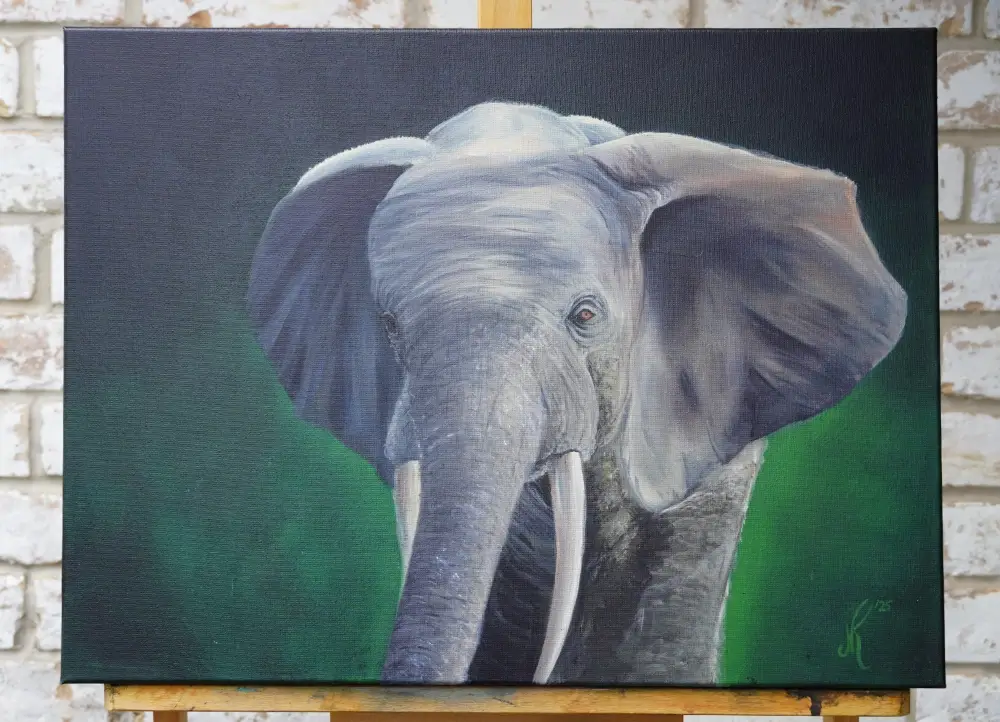
Meet the African Forest Elephant
For many years, the African forest elephant and the African savanna elephant were considered to be the same animal with two subspecies: the savanna/bush elephant and the forest elephant. Even though scientists had proposed it long before then, it wasn’t until 2021 that the IUCN separated the forest elephant into its own species from the bush elephant. In that time, we’ve come to learn about the forest elephant’s role as a keystone species in the rainforests they roam.
However, there is still much to learn about these animals and their lives, and we must support this species just as they support others in their ecosystem.
Scientific Name: Loxodonta cyclotis
Phylum: Chordata
Order: Proboscidea
Genus: Loxodonta
Kingdom: Animalia
Class: Mammalia
Family: Elephantidae
Species: L. cyclotis
IUCN Redlist Status:
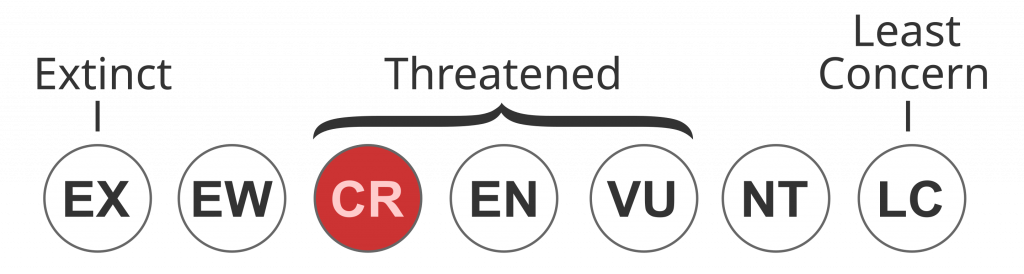
The African forest elephant is currently listed as Critically Endangered by the IUCN. The latest major assessment, published in 2025, estimates about 135,690 African forest elephants in surveyed areas, with additional elephants likely living in areas where population estimates are less certain.
- Meet the African Forest Elephant
- Where do African Forest Elephants Live?
- What do they look like?
- When Were they discovered?
- Make It Dirty: What African Forest Elephants Eat
- Meet Me in the Bai: Forest Elephant Families
- Elephant Empaths
- Bones of the Beasts
- Elephants and Us
- Addressing the Elephants in the Room
- Ele-Fun Facts
- Why do African Forest Elephants matter?
- Threats and Conservation Challenges
- How You Can Help the African Forest Elephant
- Did This Species Surprise You?
- African Forest Elephant Factsheet
- Resources
- Shop Bestsellers
Where do African Forest Elephants Live?
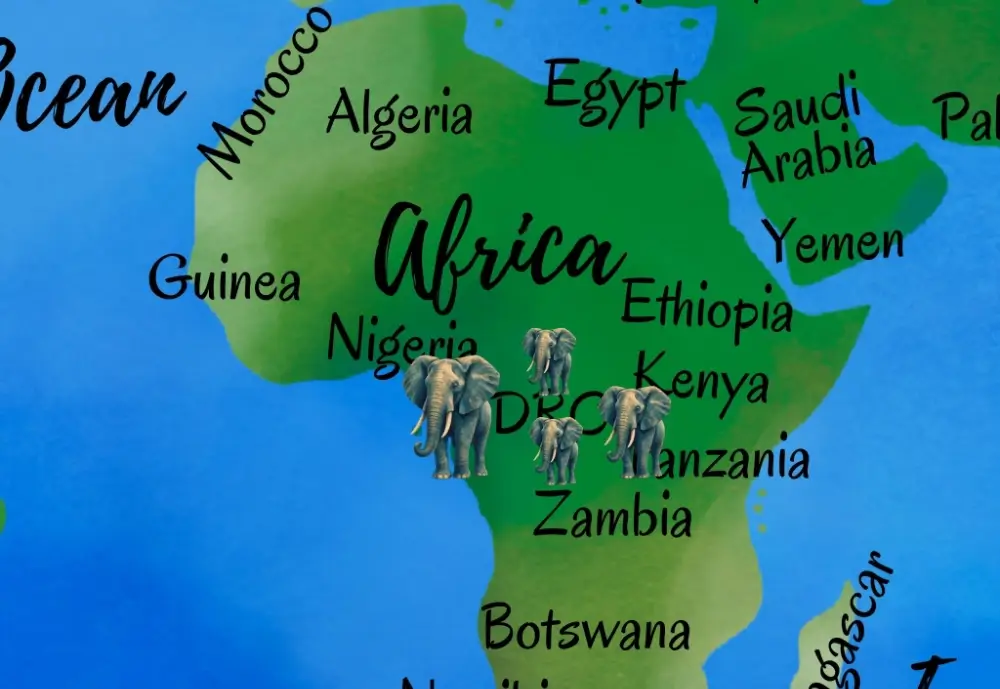
As the name suggests, the African forest elephant primarily lives within dense rainforests, though they can also be found in the savanna. During certain times of the year, forest elephants will travel to “bais” – forest clearings where groups of elephants gather to socialize and eat.
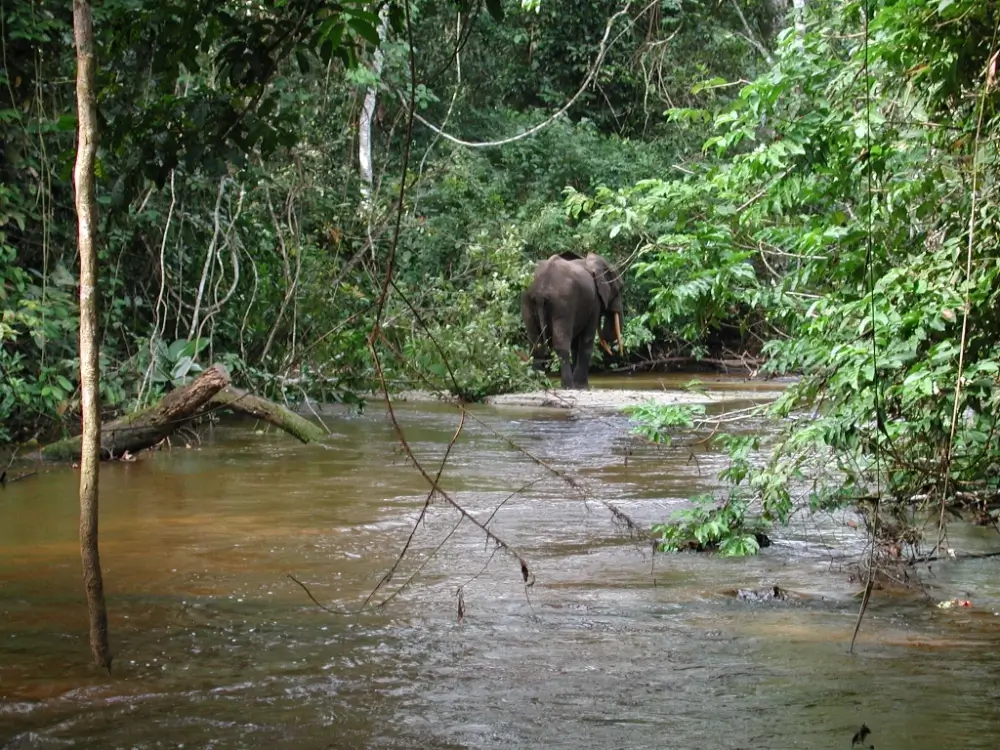
Given that these elephants can tip the scales at 2 to 5 tons, they have little trouble making their way through the woods. Other species like chimpanzees, forest buffalo, pangolins, and even humans will use forest elephant trails to make travel easier, like a natural highway.
The forest elephant’s range occupies western and central Africa, with the largest population living in Gabon. However, habitat destruction due to logging and the loss of elephants to poaching has pushed the species out of 75% of their historic range.
What do they look like?
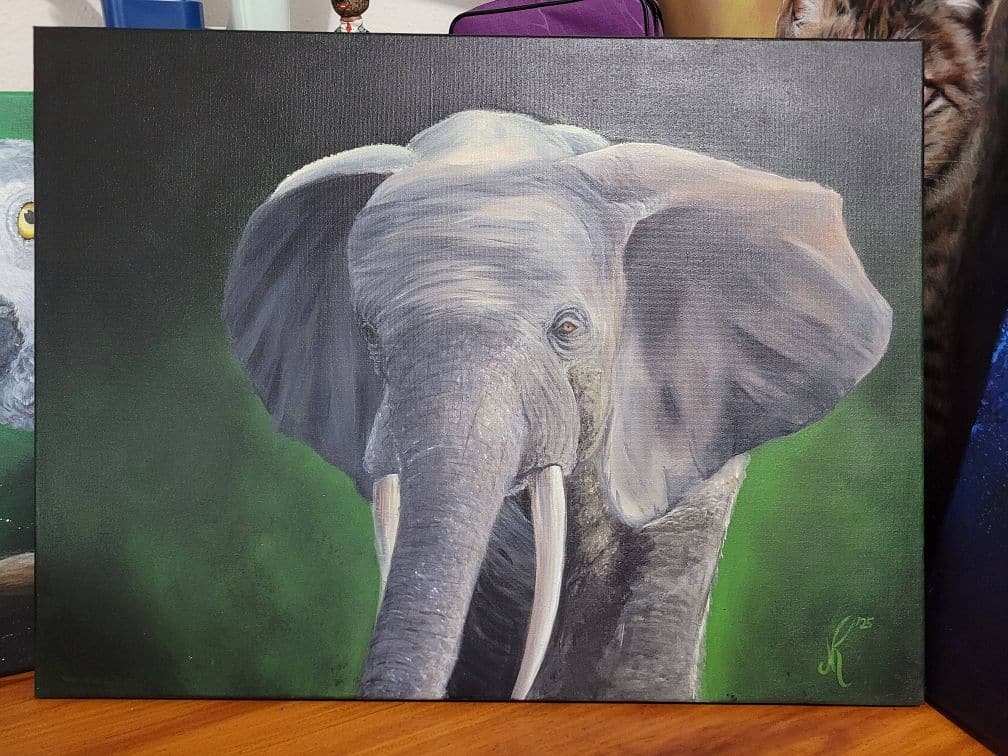
African forest elephants can grow between 8 and 10 feet from shoulder to toe in height. It’s an impressive size for humans but surprisingly small compared to their cousin, the African savanna elephant (which reaches an astounding ten to thirteen feet). The African forest elephant has large, generally rounded ears that, in addition to hearing, help them regulate their body temperature.
The forest elephant has fairly straight tusks that point downward, unlike the more outward-curving tusks of the African savanna elephant. Both male and female forest elephants grow tusks, although males generally develop larger, heavier ones. One particularly impressive male was recorded with tusks reaching a whopping 2410 millimeters – nearly 2.5 meters (8 feet) long! The tusks have a slight pinkish coloration, in contrast to the elephant’s dark gray skin, and are known for their density.
Like all elephants, the forest elephant sports a tremendously strong trunk that functions as a Swiss Army knife. A forest elephant’s trunk helps them breathe, smell, eat, drink, communicate, and push and pull objects in their environment. One trunk contains 40,000 muscles, while the human body only has 6,000!
When Were they discovered?
Given that they spend most of their lives in the dense rainforest, forest elephants are much more difficult to observe than their savanna counterparts. Due to the forest elephant’s elusiveness, scientists took a while to figure out if they were just a subspecies of savanna elephant or their own unique animal.
One of the first recorded discoveries was by German zoologist Paul Matschie in 1900. He studied the skulls of a male and female forest elephant found in the Sanaga River in Cameroon, and from those studies he proposed “Loxodonta cyclotis” as a new elephant species.
However, it wasn’t until 2010 that scientists found more concrete differences between savanna and forest elephants. One study focused on the genetics of the extinct woolly mammoth and the mastodon. As part of the study, researchers compared the DNA of woolly mammoths and mastodons with Asian and African elephants. The comparison of savanna and forest elephant DNA revealed that the two species split off from each other sometime between 2.5 and 5 million years ago. In fact, the forest elephant was as different from the savanna elephant as Asian elephants were from woolly mammoths.
Finally, the International Union for Conservation of Nature (IUCN) recognized the African forest elephant as its own species in 2021. As its own species, the forest elephant received an updated report of their population numbers and conservation status.
Make It Dirty: What African Forest Elephants Eat
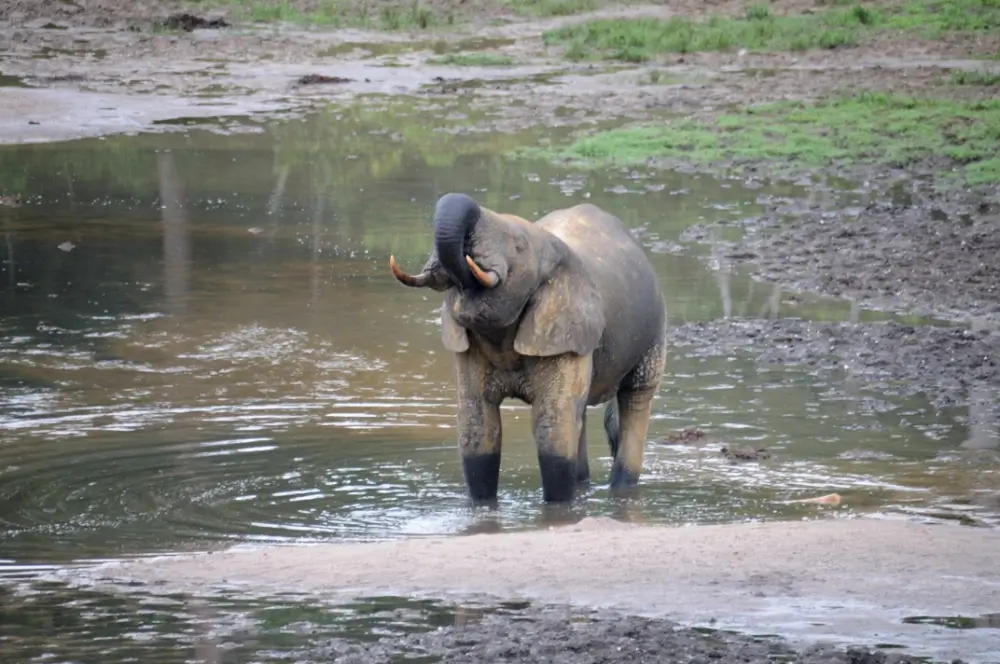
The rainforests where African forest elephants live offer them a variety of fruits and seeds to eat, as well as leaves and bark from the trees surrounding them. However, you may also see elephants eating soil. This seemingly strange choice is actually how forest elephants introduce important minerals into their diet that veggies cannot.
Alternatively, these minerals can be found in the water of bais frequented by forest elephants. They access the mineral water by digging with their feet and trunks. By eating the plants and digging for minerals in the water, forest elephants maintain the clearings year after year.
Meet Me in the Bai: Forest Elephant Families
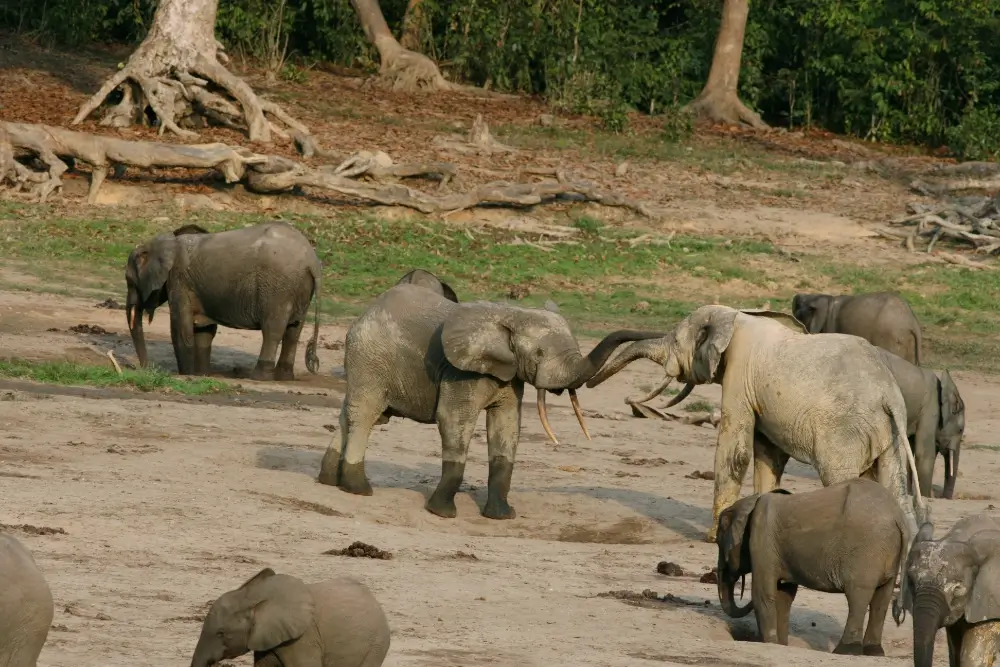
African forest elephants live in small family groups made of the mother and her immediate offspring, called “calves.” However, they occasionally come together in larger groups around bais to meet and interact with extended family. These gatherings can include large numbers of family members, and even multiple social groups, and occur roughly at the same time each year.
In addition to offering food and water, bais provide elephant calves a place to socialize with other calves. The open space makes spotting predators easier, which helps keep the calves safe. This visibility also allows scientists to study forest elephants and their social bonds.
As young males reach adolescence around 14, they begin leaving their family groups. Adult males may spend much of their time alone, but they maintain social relationships with other elephants and visit bais, where they can interact with others and find potential mates. Females, meanwhile, remain part of complex social networks that can include several related families.
Elephant pregnancies last 22 months (the longest of any living mammal), so they reproduce extremely slowly. The average lifespan of a forest elephant is 60 to 70 years, but because a female can give birth only every five or six years, the species is especially vulnerable to poaching.
Elephant Empaths
We say that an elephant never forgets. Indeed, all elephant species are remarkably intelligent and emotional. They have the largest brains of any living land mammal, and have a well-developed hippocampus: the part of the brain responsible for processing memories and spatial navigation. It should be noted that, due to their elusiveness and relatively new recognition as a distinct species, scientists are still learning more about the specifics of forest elephant intelligence, though they are likely as smart as their cousins.
Scientists have observed elephant species returning to specific locations to find water and food, suggesting elephants can remember and retrace routes. Younger elephants then learn from the adults by watching and copying their behavior, preserving the map for the next generation. Some elephants have also demonstrated tool-use, although not to the same degree as humans and other great apes. Elephants can grab branches and sticks with their trunks, and use them to scratch themselves or to swat at flies. Scientists call this behavior “fly switching”.
In addition, elephants demonstrate forms of emotional intelligence. One study on savanna elephants observed adult elephants protecting their calves from possibly distressing situations before the calves became distressed. This protection involved stopping play-fights between two calves or guarding calves from other elephants with the adult’s own body, and suggests that elephants can predict when a calf will feel unsafe.
Bones of the Beasts
Some legends tell of elephants traveling to specific places to die. However, scientists think these so-called “elephant graveyards” have more to do with migratory patterns than an ancestral call to a resting place.
Since elephants return to the same places year after year, spots with multiple elephant remains may be stops along those paths with lots of food or water. Elderly elephants might have traveled there in an attempt to refuel their aging bodies. Alternatively, there may have been a drought in the past that killed off elephants in larger numbers.
Nevertheless, elephants do take interest in these skeletons. Elephants will gather in groups to touch and interact with the bones of fallen elephants, and the fact that they return to these sites may imply a level of mourning or remembrance for the dead. However, BBC Wildlife notes that elephants did not behave differently when interacting with the bones of a family member as opposed to an unfamiliar elephant.
Elephants and Us
Though elephants have never been domesticated, they have played an important role in different aspects of human society for thousands of years. From warfare, labor, and royal processions to tourist attractions and the circus, elephants have been a big part of our fascination. Unfortunately, that very fascination with their size, intelligence, and social nature has not always translated into good treatment and animal welfare.
As we’ve learned more about their complex social lives and needs, attitudes toward using elephants for entertainment have changed. Performing elephants have disappeared from many circuses, and practices such as elephant rides and other close-contact tourist experiences are increasingly being questioned or restricted.
Curious about their complicated history? From ancient war elephants and Roman spectacles to Old Bet, Jumbo, the circus, and modern elephant tourism, read From Circus Stars to Conservation Icons: How Elephants Changed the Way We See Animals in Entertainment.
Addressing the Elephants in the Room
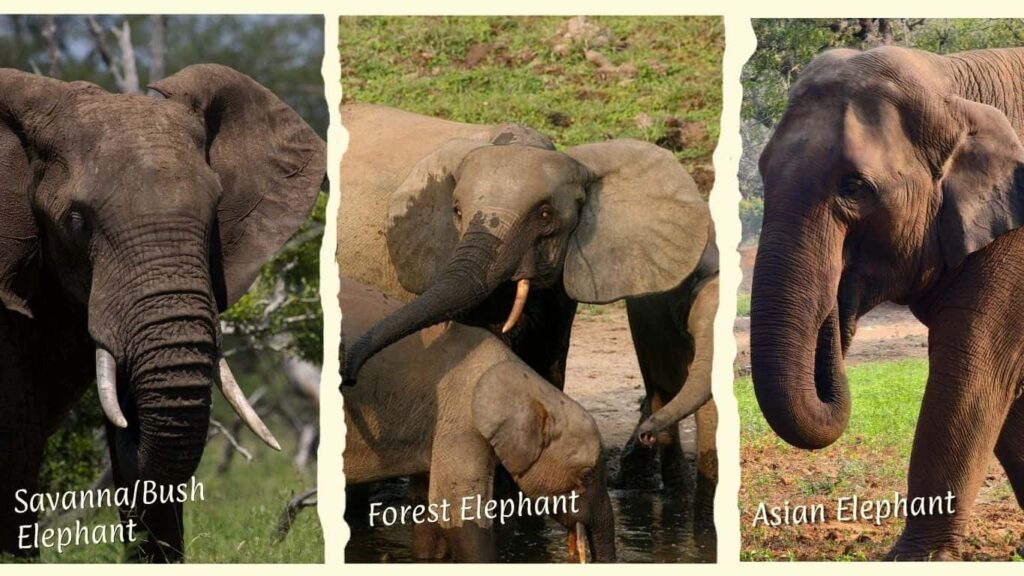
Since scientists took several years to classify the forest elephant and the savanna elephant as different species, you might think it’s impossible to tell the two apart at a glance. Luckily, there are a few good tricks to help differentiate each species of elephant.
African Savanna Elephant (AKA the African Bush Elephant): These elephants are the largest living elephants, coming in at 8 to 13 feet in height at the shoulder and 3 to 7 tons weight. Males are considerably taller than females. When viewed from the front, the top of the head appears relatively broad and flat, especially compared with the more rounded head of the forest elephant and the double-domed head of the Asian elephant. Its ears are enormous and roughly triangular. Their outline is often compared to the shape of the African continent. Both males and females typically grow tusks, which generally curve outward and upward. Like forest elephants, savanna elephants have two finger-like projections at the tip of the trunk. Savanna elephants tend to live in large, matriarchal herds. The IUCN currently lists the savanna elephant as Endangered.
African Forest Elephant: The forest elephant is slightly smaller than the savanna elephant, and typically stands at about 8 to 10 feet (2.4–3 m) tall at the shoulder and weighs roughly 2 to 5 tons. Its head is more rounded than the relatively flat-topped head of the savanna elephant, and its ears are smaller and rounder, too. Similar to the savanna elephant, both males and females grow tusks. The main difference is that theirs tend to be straighter and point down towards the ground as opposed to the savanna elephant’s forward-facing tusks. Forest elephants also have two finger-like projections at the tip of their trunks. They usually live in smaller family groups instead of large herds, although many elephants may gather and socialize at bais. The IUCN currently lists the forest elephant as Critically Endangered.
Asian Elephant: Asian elephants are similar in size to African forest elephants, reaching 6.5 to 11.5 feet in height at the shoulder and roughly 2.75 to 5.5 tons. Males are generally larger than females. Besides their much smaller ears and shorter tusks than African elephants, one of their most distinctive features is the double-domed head, with two rounded bulges separated by a shallow indentation. It always reminds me of the top of a heart when viewed from the front. Additionally, only the males of the species grow large, visible tusks. Females and some males may instead have much smaller tusk-like teeth called tushes. The Asian elephant’s trunk has only one “lip”, or finger-like projection, at the end, as opposed to both species of African elephant, which have two. Asian elephants may also have noticeable areas of pinkish depigmentation that can look almost like light freckles, particularly around the ears, forehead, and trunk. They live in matriarchal family groups, with females generally remaining with their families while males leave as they mature. The IUCN currently lists the Asian elephant as Endangered.
Myth or Fact:
Are Elephants Afraid of Mice?
MYTH!
Despite what cartoons may have taught us, there is no scientific evidence that elephants have a special fear of mice. An elephant might be startled by a mouse suddenly darting around its feet, but can be easily explained by the unexpected movement, not because a tiny rodent is particularly terrifying.
So, no: a mouse isn’t an elephant’s secret nemesis.
Want to know something even stranger? Elephants really do try to avoid bees! Researchers have found that elephants respond to the sound and scent of disturbed honeybees, and some farmers in Africa even use beehive fences to help protect crops from hungry elephants.
Ele-Fun Facts
- Nature’s Gardeners: African forest elephants spread the seeds of fruit they eat through their dung. The poop serves as an excellent fertilizer, helping the new seeds grow in new areas throughout the forest. In this way, forest elephants take care of the rainforests that take care of them.
- Swim Trunks: Despite their size, forest elephants are surprisingly good swimmers. Plus, their long trunks double as their own personal snorkels!
- Listening Feet: Like other elephants, forest elephants can communicate with each other long distances using infrasound. These low-frequency sounds, including some below the range of human hearing, create seismic waves that can travel an estimate of 800 meters through the noisy rainforest, and potentially miles when conditions are great, allowing them to detect and communicate with other elephants hidden in the trees. In addition to their ears, forest elephants detect infrasound with vibration-sensitive pads in their feet!
- Body Language: Forest elephants also communicate through their body language. By moving their heads, ears, and tails in specific ways, elephants can signal aggression, fear, or playfulness. The trunk of an elephant is especially expressive, and elephants use them to comfort or threaten other elephants with gentle brushes or abrasive shoves.
- Memory Maps: Forest elephants remember the locations of fruiting trees and mineral-rich clearings over enormous areas of rainforest.
- Pretty in Pink: Some describe the forest elephant’s tusks as having a pinkish hue. In addition, baby forest elephants can have pink underbellies!
- Four on the Floor: Forest elephants physically cannot jump. Jumping occurs when tendons in the leg and foot stretch as you bend your legs, then snap back into place to push you upwards. Elephants, though, cannot stretch their tendons very much, keeping their large bodies earthbound. Luckily, elephants don’t need to jump. They don’t have to leap to catch prey, and their size means they don’t have to jump to avoid predators.
Why do African Forest Elephants matter?
In addition to building the rainforest’s natural highways, forest elephants help combat climate change through their diet. By spreading the seeds of fruits and fertilizing them with their dung, the forest elephant helps grow more trees that capture carbon dioxide (CO2) via photosynthesis to cool the surrounding environment.
A Nature Geoscience study found that forest elephants reduce the density of smaller trees and vegetation as they move and feed through the forest, giving larger, slower-growing trees with denser wood more room to thrive. Researchers estimated that losing forest elephants could reduce the aboveground biomass of Central African rainforests by around 7%, potentially reducing the amount of carbon those forests can store. Or, in other words, forest elephants help keep the ecosystem in balance.
Losing forest elephants means losing the environment’s engineers, restricting the spread of plant life and increasing competition for nutrients. Plants that rely nearly exclusively on the forest elephant to eat and disperse their seeds would suffer greatly, and the lack of new trees would reduce the forest’s ability to store carbon from the atmosphere.
Elephants not only support species in their ecosystems, but also endangered species around the world. Their iconic features of trunks and tusks paired with their vast intelligence make elephants easy to recognize and feel empathy for. Elephants are common symbols of wildlife conservation movements around the world and are considered a flagship species: animals that raise awareness and support for conservation efforts by appearing on marketing materials.
Threats and Conservation Challenges

Even though the African Forest Elephant was only recognized by the IUCN as its own species in 2021, it remains critically endangered and may be lost before we can fully understand the hidden complexities in these animals.
Habitat Loss and Infrastructure Development: Much of the forest elephant’s historic range has been lost due to deforestation. The removal of these trees for logging companies also makes way for human infrastructure like oil and rubber plantations, simultaneously driving forest elephants away while also bringing them into more frequent contact with humans.
Conflict with Humans: Elephants will eat and trample crops across nearby farms, and their large size can cause damage to infrastructure as well. These incidents often lead to farmers retaliating with firearms to defend their property, and the resulting conflicts have led to both human and elephant deaths.
Poaching: The tusks of forest elephants make them a prime target for ivory poachers. According to the African Wildlife Foundation, around 62% of forest elephants were killed for their ivory in a single decade between 2002 and 2011. Many ivory carvers prefer forest elephant tusks in particular because they are denser.
Climate Change: The warming climate threatens forest elephants by decreasing the yield of ripe fruit in forests. Since their large size requires lots of foraging to sustain, forest elephants will be greatly impacted by climate-caused food shortages.
How You Can Help the African Forest Elephant
- Choose FSC-Certified Wood and Paper: Illegal logging is one of the biggest threats to African rainforests. When purchasing wood products, furniture, paper, or flooring, look for the Forest Stewardship Council (FSC) certification. FSC-certified products come from responsibly managed forests that help reduce habitat destruction.
- Buy Rainforest-Friendly Chocolate and Coffee: Many products grown in tropical regions can contribute to deforestation if produced unsustainably. Choosing Rainforest Alliance Certified or similarly certified coffee, cocoa, and tea supports farming practices that better protect wildlife habitat.
- Never Buy Ivory: Avoid purchasing ivory products or souvenirs, even antiques, unless you know they comply with wildlife laws. Every informed purchase helps reduce demand for elephant ivory and discourages illegal poaching.
- Share Their Story: Most people have never heard of the African Forest Elephant. Sharing a conservation article, factsheet, or social media post can help introduce others to this lesser-known species and the challenges it faces.
- Reduce Your Paper Waste: Using both sides of paper, choosing recycled paper products, and reducing unnecessary printing can help decrease demand for timber and reduce pressure on forests worldwide.
- Support Ethical Zoos and Conservation Organizations: Many accredited zoos and conservation organizations contribute to elephant research, anti-poaching efforts, and rainforest conservation. Even small donations or memberships help fund important work. Some charities that focus on elephant conservation include the International Elephant Foundation and Sheldrick Wildlife Trust.
- Plant a Tree: While planting a tree won’t directly restore African rainforest habitat, supporting local reforestation projects or organizations that restore tropical forests helps combat climate change and raises awareness about the importance of healthy forests.
- Learn Before You Share: Help fight wildlife misinformation by learning from reputable conservation organizations and sharing accurate information with friends, family, and on social media.
- ♻️ Reduce Your Carbon Footprint: Climate change affects rainforest ecosystems and the fruiting cycles of many tree species that forest elephants depend on. Walking, biking, conserving energy, and reducing waste are small actions that collectively make a difference.
- Raise awareness through social media about these elephants and the dangers they currently face.
- Lastly, Shop with purpose: Purchases from Artsefact help support wildlife and habitat conservation.
Buy Art & Save Wildlife
10% of all profits support wildlife and habitat conservation efforts, so every artwork you collect helps protect the planet.



Did This Species Surprise You?
Before today, did you know there were two different species of African elephants? What fact surprised you the most? Share your favorite discovery in the comments or on social media and help others learn about this incredible species.
African Forest Elephant Factsheet
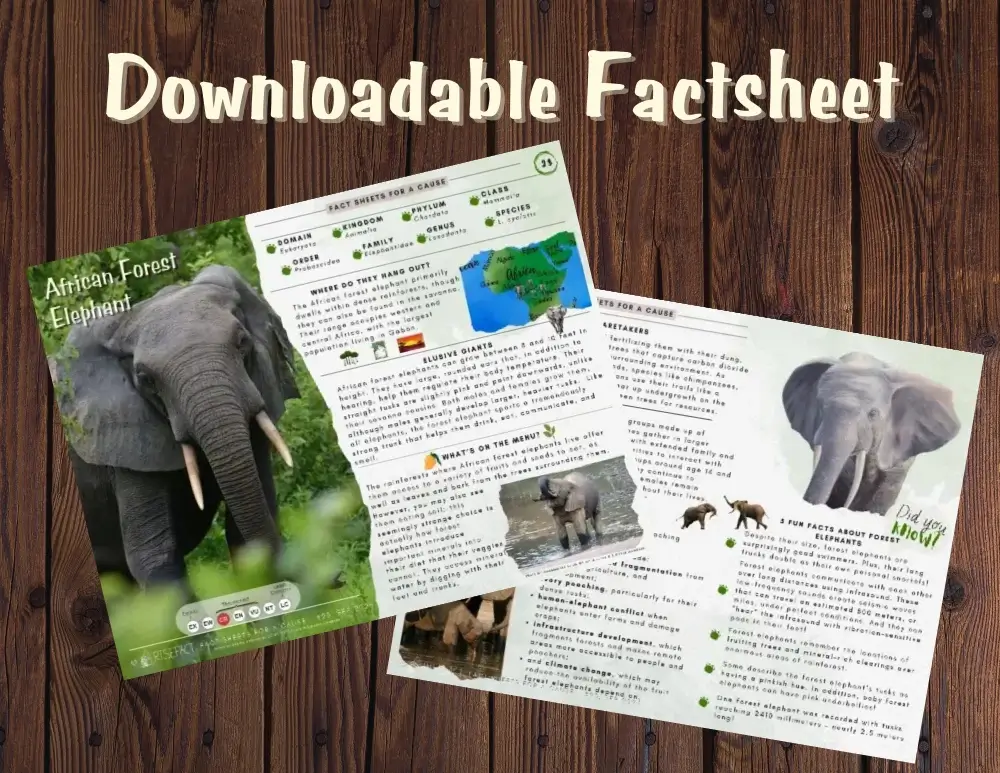
Would you like an African Forest Elephant fact sheet?
- Sign up for our newsletter for exclusive updates and wildlife conservation tips (Your welcome email has your Password for the Portal)
- Visit https://artsefact.com/factsheets/ where you can access and download ALL Factsheets & Gain Early Access to NEW Factsheets
Here’s how you can gain access:
Resources
- Elephant: “Living African elephants belong to two species: Loxodonta africana (Blumenbach, 1797) and Loxodonta cyclotis (Matschie, 1900)” – https://digitalcommons.wayne.edu/cgi/viewcontent.cgi?article=1140&context=elephant
- IUCN Redlist – https://www.iucnredlist.org/species/181007989/204404464#geographic-range
- World Wildlife Fund:
- https://africa.panda.org/?57064/First-status-report-on-the-African-forest-elephant-Giants-of-the-forest-in-danger
- https://www.worldwildlife.org/species/elephant/african-elephant/african-forest-elephant/
- https://www.worldwildlife.org/species/elephant/african-elephant/african-savanna-elephant/
- https://www.worldwildlife.org/species/elephant/asian-elephant/
- https://www.worldwildlife.org/resources/facts/whats-the-difference-between-asian-and-african-elephants-and-9-other-elephant-facts/
- African Wildlife Foundation:
- Smithsonian Magazine – https://www.smithsonianmag.com/science-nature/how-humans-benefit-highway-trails-created-african-forest-elephants-180976045/
- Global Conservation – https://globalconservation.org/endangered-species/african-forest-elephant
- San Diego Zoo Wildlife Alliance – https://ielc.libguides.com/sdzg/factsheets/african_elephant/characteristics
- Historical Biological: “Estimating tusk masses in proboscideans: a comprehensive analysis and predictive model” – https://www.tandfonline.com/doi/pdf/10.1080/08912963.2023.2286272?needAccess=true
- Animalia – https://animalia.bio/african-forest-elephant
- National Geographic: “African Elephants Really Two Wildly Different Species?” – https://www.nationalgeographic.com/animals/article/101222-african-elephants-two-species-new-science
- Wildlife SOS – https://news.wildlifesos.org/8-fascinating-facts-about-an-elephants-trunk/
- NASA – https://science.nasa.gov/earth/earth-observatory/dzanga-bai-elephant-enclave-149945/
- Cornell University:
- Mongabay – https://news.mongabay.com/2026/04/a-unique-clearing-in-central-africa-draws-elephants-from-the-dense-forests/
- National Library of Medicine: “Memory-Based Navigation in Elephants: Implications for Survival Strategies and Conservation” – https://pmc.ncbi.nlm.nih.gov/articles/PMC12030947/#sec2-vetsci-12-00312
- Wikipedia:
- “African forest elephant” – https://en.wikipedia.org/wiki/African_forest_elephant
- “Old Bet” – https://en.wikipedia.org/wiki/Old_Bet
- “Flagship species” – https://en.wikipedia.org/wiki/Flagship_species
- The Guardian: ” ‘The end of an era’: Ringling Bros circus closes curtain on elephant shows” – https://www.theguardian.com/stage/2016/may/02/ringling-brothers-elephants-circus-final-show
- Mamamia: “A life of abuse and a tragic end: The true story of the real-life Dumbo.” – https://www.mamamia.com.au/dumbo-real-story-jumbo-the-elephant/
- Science Direct:
- “Large brains and cognition: Where do elephants fit in?” – https://pinterwollmanlab.eeb.ucla.edu/wp-content/uploads/sites/86/2016/05/elephant-cognition-2008.pdf
- “Megagardeners of the forest – the role of elephants in seed dispersal” – https://www.sciencedirect.com/science/article/abs/pii/S1146609X11000154
- Journal of Consciousness Studies: “Do Elephants Show Empathy?”- https://dspace.stir.ac.uk/bitstream/1893/946/1/2008%20Bates_et_al_JCS.pdf
- Elephant Voices:
- KQED – https://www.kqed.org/science/1926248/how-elephants-listen-with-their-feet
- Elephant Aid International – https://elephantaidinternational.org/fun-facts/why-elephants-cant-jump/
- BBC Wildlife – https://www.discoverwildlife.com/animal-facts/mammals/elephant-graveyards-truth
- The Living Lore: “Elephant Symbolism and Cultural Significance” – https://thelivinglore.com/elephant-symbolism-and-cultural-significance/
- Wissenschaftskolleg zu Berlin: The Conservation Applications of Research on Elephant Behaviour and Ecology” – https://www.wiko-berlin.de/veranstaltungen/workshops/2017/the-conservation-applications-of-research-on-elephant-behaviour-and-ecology
- Nature Elephant Fact Sheet https://www.pbs.org/wnet/nature/blog/elephant-fact-sheet/
- https://www.birds.cornell.edu/ccb/elephant-listening-project/forest-elephants
- https://www.elephantsanctuary.co.za/blog/140-are-elephants-afraid-of-mice
- https://globalelephants.org/elefact-friday-of-mice-and-elephants/
- https://www.nature.com/articles/s41561-019-0395-6
- https://pubmed.ncbi.nlm.nih.gov/32972990/
Shop Bestsellers
No products found.


