

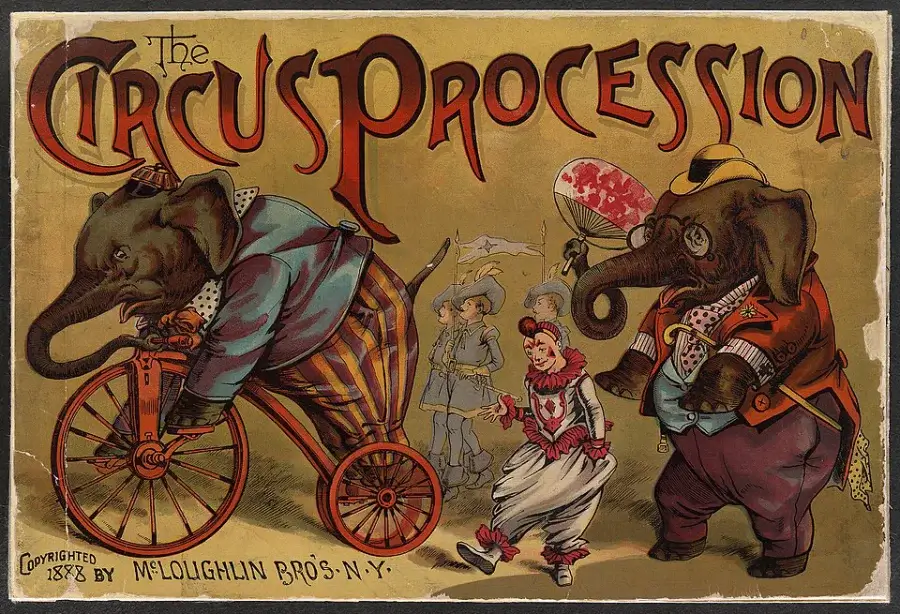
How Elephants Changed the Way We See Animals in Entertainment
When I was a child, the circus coming to town was a big deal.
And I mean a big deal for the whole family! We’d all go to the circus together. Even our schools organized field trips. Posters appeared around town announcing its arrival, and everyone seemed to know when the circus was coming. Oh, the anticipation when we first saw the caravans pulling up and putting up the tent!
In many ways, it felt a little like going to the movies today, except much bigger and far more exciting. I can still smell the concession stands filled with popcorn, candied apples, and other treats. My memories are filled with excitement and awe. Often, the clowns didn’t just perform somewhere in the distance; they involved us kids in the show in one way or another. You weren’t just watching the spectacle; you became part of it!
But for us kids, the animals were often the biggest highlight. Elephants, horses, llamas, lions and tigers, monkeys… They had them all, and you had the chance to see animals you might otherwise only see in books or at the zoo. And then you got to watch them do things that seemed almost impossible.
Seeing an elephant in person felt magical, especially at a time when experiencing wildlife from around the world wasn’t as easy as opening an app on your phone. The idea that there might be anything wrong with seeing these animals perform simply wasn’t part of the conversation most of us were having.
Animals and circuses became a huge part of some of my fondest childhood memories. I still have a personalized children’s book in which my family, friends, and I join a circus adventure and rescue an elephant. And when I was in elementary school, I once helped a Dompteur (the German word commonly used for an animal trainer) and the circus director catch a runaway llama just down the road from my school!
I loved animals then just as much as I do now.
What I didn’t understand as a child was what life behind the curtain could look like for the animals entertaining us.
As I grew older, that slowly began to change. Animal-welfare campaigns became more visible as we learned more about how intelligent and socially complex elephants truly are. More and more things came to light about the methods sometimes used to train and control performing animals. It became increasingly difficult to ignore the questions surrounding them. The concerns themselves weren’t necessarily new; even when I was a child, the mistreatment of circus animals was already frowned upon. But… circuses could be very good at keeping what happened behind the scenes out of the public eye. What audiences saw were healthy-looking animals entering the manege (circus ring), performing alongside their trainers, and becoming part of the spectacle. We didn’t necessarily see how they were trained, transported, housed, or treated when the show was over.
My experience was hardly unique. Many Millennials and Gen Zers grew up during an extraordinary transition: old enough to remember elephants and other exotic animals as a normal part of the circus, but young enough to watch public attitudes toward them change dramatically.
And elephants weren’t simply caught up in that change.
They became one of its most recognizable symbols.
A History Older Than the Circus
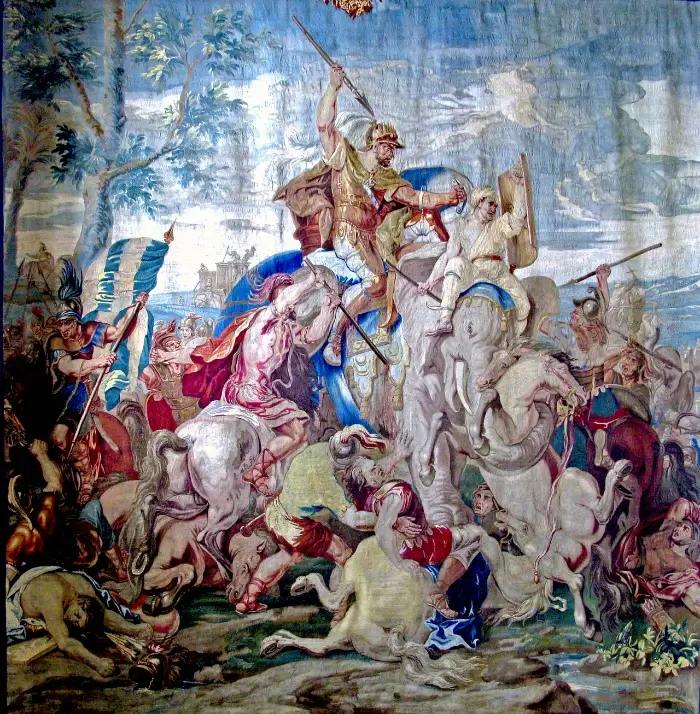
Our fascination with performing elephants began long before the modern circus.
Elephants have played many roles around the world, from agriculture, transportation, and heavy labor to royal collections, public processions, spectacles, and even warfare. For centuries, their sheer size and power made them incredibly valuable and intimidating! From Asia and North Africa to the Mediterranean, war elephants created fear and confusion on the battlefield. It comes as no surprise that in the Roman Empire, exotic animals, including elephants, were displayed in arenas and sometimes even forced to fight animals or humans for entertainment.
Just imagine seeing an elephant in the ancient world! There were no skyscrapers, no 18-wheelers or buses. Only a few things in their everyday life could prepare them for the sheer scale of an elephant. Now picture one of them charging at you on a battlefield! It’s easy to see why they can inspire both awe and terror…
Over time, the roles elephants played alongside humans changed, but our fascination with them did not. As their use on battlefields declined, elephants continued to be displayed, paraded, and exhibited. Centuries later, that same sense of awe would help make them some of the greatest attractions of traveling menageries, and eventually, the circus.
Before wildlife documentaries, TV, photography, zoos, and the internet, most people could go their entire lives without seeing an elephant. A traveling menagerie arriving in town offered something almost unimaginable: the chance to stand only a few feet away from an animal many only knew from stories and illustrations.
As circuses and menageries began joining forces during the 19th century, exotic animals became an increasingly important part of the spectacle. Historical circus records show combined menagerie-and-circus exhibitions appearing in the United States by the 1820s.
And few animals could attract attention quite like an elephant.
Old Bet: An Early American Elephant Celebrity

One of America’s earliest elephant celebrities was Old Bet, who was exhibited by Hachaliah Bailey as early as 1808. Keep in mind, this was well before the invention of the (photo) camera, decades before photography became readily available. Suffice to say, most Americans had never seen an elephant. Bailey leveraged that and traveled from town to town, charging people for the opportunity to see her, essentially helping pave the way for the traveling menageries that would later become closely intertwined with the circus.
Unfortunately, Old Bet’s story came to a tragic end in 1816, when she was shot and killed in Maine. One account claims the shooter objected to people spending their money to see an exotic animal, although his exact motive remains uncertain. Even Old Bet’s species is debated, with historical accounts identifying her as either an African or Asian elephant.
Still, her popularity demonstrated something that future showmen would capitalize on:
People wanted to see elephants.
Jumbo: The Elephant Who Became Larger Than Life
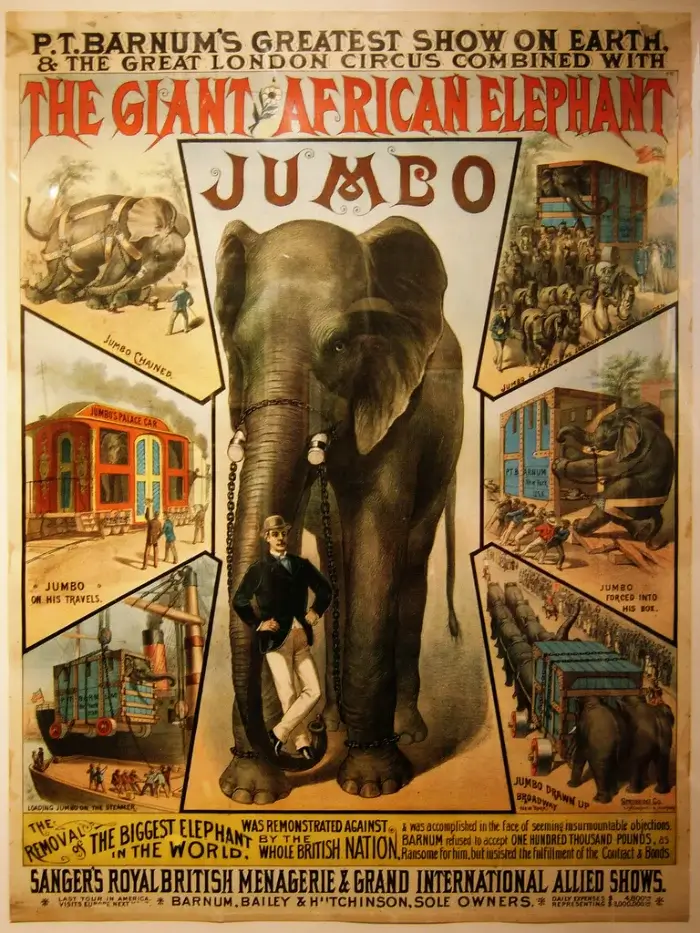
More than half a century later, an African elephant named Jumbo became one of the most famous animals in the world.
Jumbo was already very popular at the London Zoo when showman P. T. Barnum purchased him in 1882 and brought him to the United States. Standing roughly 11 feet tall and weighing several tons, Jumbo was certainly impressive, although Barnum (master of sensationalism and promotion that he was) was more than happy to exaggerate his size even further.
Jumbo became an American sensation, but his greatest legacy may be hiding in plain sight.
Today, we casually use jumbo to describe everything from jumbo shrimp to jumbo-sized drinks, often without realizing that the word’s association with enormous size was popularized by this very real elephant.
Interestingly, Jumbo was also somewhat unusual among the elephants that became common in Western circuses.
He was African.
Historical records generally identify Jumbo simply as an African elephant. During his lifetime, African forest and savanna elephants weren’t recognized as the separate species we know today, making it difficult to confidently assign him to either one using modern classifications.
Jumbo’s African origins also set him apart from many of the elephants that would later perform in Western circuses: Asian elephants. Especially female Asian elephants became far more common.
This raises an interesting question: why?
Why Were So Many Circus Elephants Asian?
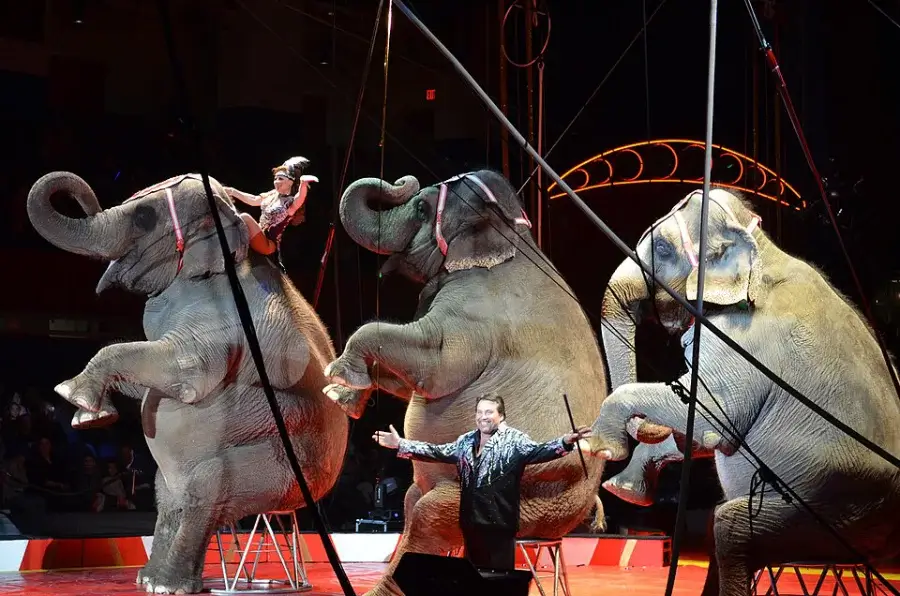
Both African and Asian elephants appeared in circuses, but historically, Asian elephants (particularly females) became far more common performers.
There wasn’t just one reason.
Asian elephants are generally smaller than African savanna elephants, which is an obvious advantage when an animal weighing several tons had to be transported from town to town. Circus trainers also historically considered Asian elephants easier to handle and train. Females were particularly favored because adult males periodically experience musth, a natural hormonal state associated with major behavioral changes and increased aggression.
Another important factor was that humans already had a very long history of working alongside Asian elephants. For centuries, elephants in parts of Asia had been captured and trained for transportation, logging, ceremonies, warfare, and other forms of work. Therefore, they had gained a lot of knowledge about how to handle and even train them long before the rise of the Western circus. This also meant that they were usually far easier to obtain.
But there’s an important distinction hidden in that history:
Elephants are not domesticated animals.
Humans can habituate and train individual elephants, but that isn’t the same thing as domestication. Unlike animals such as dogs, cattle, and horses, elephants have not undergone the population-wide process of domestication that transformed those species over many generations.
That meant circus trainers were still faced with an extraordinary challenge: convincing one of the world’s largest and most powerful wild animals to reliably perform on command.
So how do you control an elephant?
The Golden Age of the Circus Elephant
By the late 19th and into the 20th century, elephants had become almost inseparable from the popular image of the circus.
And the circus was designed to be a spectacle.
There was music, sparkling costumes, bright lights, clowns, acrobats, parades, and performers attempting feats that seemed almost impossible. Then, of course, there were the animals, everything from horses to exotic wildlife, like tigers and elephants. Everything was meant to feel bigger, louder, more colorful, and more extraordinary than everyday life.
Elephants appeared on posters and in parades. Beneath the big top, they marched trunk-to-tail, carried riders, balanced on pedestals, stood on their hind legs, and performed carefully choreographed routines, often dressed in their very own colorful, sparkly costumes with tassels up the wazoo.
Part of the fascination was simply trying to understand how an animal so enormous could do any of it.
An elephant is impressive enough standing still. Watching an animal weighing several tons respond to subtle cues from a trainer, perform a routine, or balance its enormous body in ways that seemed almost impossible only added to the wonder.
For children especially, it could feel like magic: the music, the costumes, the laughter, the applause, and the excitement as the elephants entered the manege. It was all over their faces! Often for days after they visited the circus.
For many families, going to the circus wasn’t simply another form of entertainment.
It was an event.
Circuses offered them a chance to experience the curious and extraordinary, and elephants embodied both. For generations of children, seeing one beneath the big top may even have been one of their earliest opportunities to encounter such an extraordinary animal in person.
I certainly remember the excitement.
It’s easy to look backward with what we know today and wonder why anyone would have supported performing elephants.
Behind the Curtain
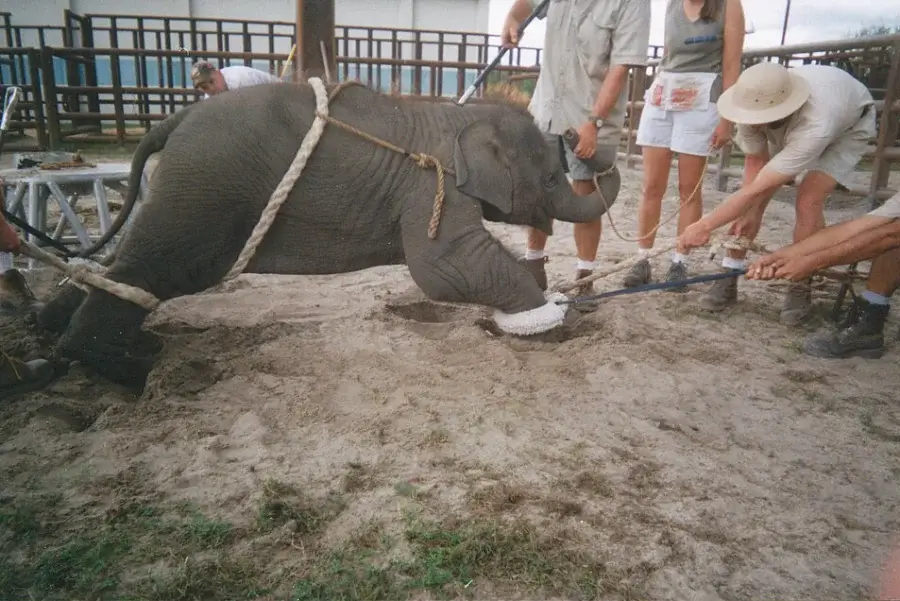
But what audiences saw inside the manege was only part of an elephant’s life.
As our understanding of elephants grew, and as animal-welfare investigations made more of their lives in captivity visible, the contrast between the spectacle and what could happen behind the scenes became more and more difficult to ignore.
We now understand elephants as highly intelligent and socially complex animals. They form long-lasting relationships, communicate across considerable distances, care for their young for years, travel over large areas, and live within intricate social networks.
Life as a traveling performer could look dramatically different.
Concerns raised by animal-welfare advocates included prolonged chaining, frequent transportation, limited opportunities for natural social behavior, separation of young elephants, and coercive training techniques.
One tool became particularly controversial: the bullhook, also known as an ankus or elephant guide.
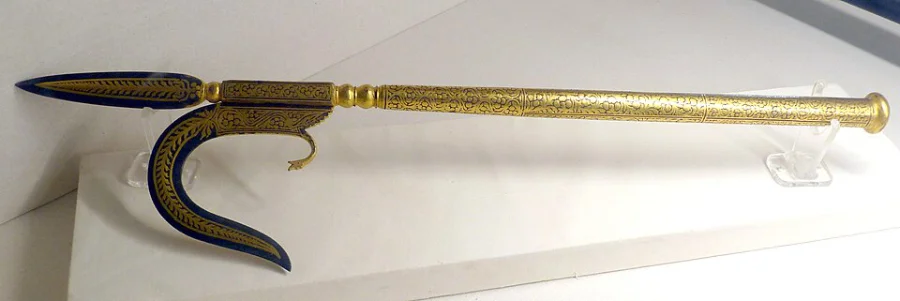
This tool consists of a handle fitted with a pointed metal hook and has historically been used to direct and control elephants. Its use became a major focus of animal-welfare campaigns, and some cities and states eventually restricted or prohibited bullhooks. By the time Ringling Bros. announced plans to retire its elephants, regulations specifically targeting elephant handling were already affecting where the circus could perform.
For audiences, the conversation was beginning to change.
The question was no longer only:
“Isn’t it incredible that an elephant can do that?”
People were also asking:
“What did it take to make an elephant do that?”
The Generation That Watched It Change
For me, the changing relationship with circus animals didn’t happen all at once.
I grew up at a time when animals were simply part of the circus. But even while I was still a child, that was beginning to change.
It wasn’t an overnight transformation, nor did every circus change at the same time. Some began moving away from larger wild animals such as elephants and big cats while continuing to feature horses, dogs, and other animals. Others held on to traditional animal acts much longer.
Germany’s Circus Roncalli is a good example of just how gradual that transition could be. It stopped using lions and elephants in 1991, but continued featuring other animals for years. By 2017, horses were its last remaining live animal act. Then, in 2018, Roncalli removed live animals from its performances altogether and found a rather spectacular replacement: massive 3D projections that create the illusion of holographic animals in the manege.
At the same time, the circus itself was evolving.
Over the years, I began noticing more shows emphasizing the extraordinary abilities of their human performers instead. And let’s be real: the control these performers have over their own bodies is simply mind-boggling! The way they bend, stretch, balance, spin, fly through the air… you name it, I’m in awe. Phew!
Acrobatics, aerial acts, magic, elaborate storytelling, and increasingly specialized themes could provide the spectacle without relying on exotic animals. Horror circuses and other themed productions offered entirely different versions of what a circus could be.
And perhaps that’s one of the most interesting parts of watching this change happen in real time: the circus didn’t disappear when the animals began disappearing from the manege.
It adapted.
The spectacle remained. The costumes remained. The music, suspense, laughter, and sense of How on earth did they just do that? remained.
But more and more, the performers inspiring that reaction were human.
And elephants would become one of the most visible symbols of that transition.
When Elephants Became the Face of Change
It would be too simple to say elephants single-handedly ended the traditional animal circus. Changing entertainment preferences, economics, legislation, and decades of animal-welfare activism all played a role.
But elephants often found themselves at the center of the debate.
Some laws and local ordinances specifically targeted elephant performances and the use of bullhooks. In Los Angeles, for example, the city council banned the use of bullhooks in 2014. For traveling circuses moving from one jurisdiction to another, the growing patchwork of local regulations also created practical challenges.
Then came one of the clearest signs of just how much things had changed.
In 2015, Ringling Bros. and Barnum & Bailey announced that it would phase elephants out of its performances. Alana Feld, executive vice president of parent company Feld Entertainment, described a “mood shift” among audiences:
“A lot of people aren’t comfortable with us touring with our elephants.”
The company also pointed to the increasing number of local regulations affecting elephant performances. Significantly, elephants were leaving while other performing animals, including tigers, dogs, goats, and camels, were still part of Ringling’s shows.
The elephant left first.
And this wasn’t just any circus animal disappearing from the program. Kenneth Feld had previously described the elephant as the symbol of the “Greatest Show on Earth” and acknowledged that the show wouldn’t be the same without them.
By 2015, his assessment was considerably simpler:
“Things have changed.”
Ringling initially planned to retire its remaining touring elephants by 2018, but later accelerated that timeline. On May 1, 2016, its final 11 performing elephants gave their last shows in Providence, Rhode Island, and Wilkes-Barre, Pennsylvania.
For an animal that had helped define the circus for more than a century, leaving the manege ahead of so many of its fellow performers said a great deal on its own.
From Jumbo to Dumbo
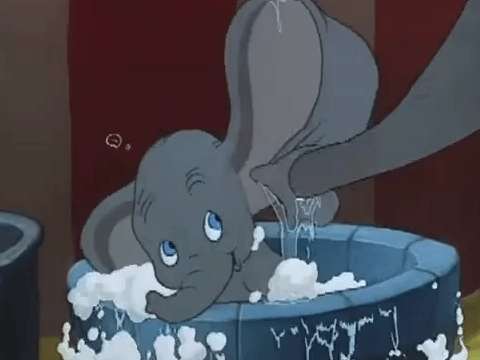
Elephants weren’t only circus stars. They became fixtures of children’s stories, movies, advertisements, toys, and popular culture.
And one particularly famous fictional circus elephant shares more than a similar-sounding name with the most famous real one.
When Disney’s Dumbo was released in 1941, its little elephant wasn’t actually named Dumbo at all.
His mother named him Jumbo Jr.
It’s only after the other elephants discover his unusually enormous ears that they mockingly begin calling him Dumbo.
The connection to Jumbo, the real African elephant whose fame had helped make his name synonymous with enormous size, is hard to miss. But Disney certainly took some artistic liberties with elephant anatomy.
Mrs. Jumbo and the other adult elephants are drawn with relatively small ears that resemble those of Asian elephants, although the film doesn’t appear to officially identify their species. And Dumbo’s ears? Well, those belong firmly in the realm of Disney magic 😛
But there’s something else about Dumbo that’s particularly interesting in the context of this story.
Even in 1941, the film didn’t portray circus life as nothing but excitement and spectacle.
Mrs. Jumbo is separated from her baby and imprisoned after trying to protect him from children who are tormenting him. Dumbo is mocked because of his appearance, separated from his mother, made into a clown, and ultimately turned into a star once the circus discovers that the very trait everyone ridiculed can make him profitable.
The circus provides the magic.
But it also provides much of the conflict.
That makes Dumbo an interesting cultural snapshot. The performing elephant is still a source of wonder, but the audience is also being asked to sympathize with the elephant when the spectacle comes at his expense.
Decades later, another famous circus-elephant story would take audiences behind the curtain much more directly.
Water for Elephants: When the Story Changed Too
The 2011 film Water for Elephants, based on Sara Gruen’s novel, is set in a struggling traveling circus during the Great Depression.
At the center of the story is Rosie, an Asian elephant acquired in the hope that she will become the circus’s newest attraction. The film deliberately contrasts the romance and spectacle of circus life with the violence and coercion taking place behind the scenes.
Rosie becomes a star in the manege, but away from the audience, her experience tells another story. The film depicts chaining, injuries, and violence involving a bullhook while simultaneously emphasizing her intelligence and her developing relationship with Jacob.
That makes Water for Elephants particularly interesting as a cultural marker.
Earlier circus stories often asked audiences to marvel at the performing elephant. Water for Elephants asks us to look behind the performance and question what creating that spectacle might cost the animal.
But there is an uncomfortable irony here.
Rosie was still played by a real performing elephant.
Tai, the Asian elephant who portrayed Rosie, was an experienced animal performer. American Humane monitored the production, and the scenes depicting Rosie’s abuse were created using special effects.
After the film’s release, however, Animal Defenders International released older undercover footage that it alleged showed Tai and other elephants being subjected to bullhooks and electric shocks while in the care of the company that supplied her for the film. The footage predated Water for Elephants by several years, and Tai’s owners disputed the allegations and said the video had been heavily edited.
The controversy raised an awkward question for a movie that was itself asking audiences to reconsider the treatment of performing elephants:
Can you tell a story condemning the exploitation of a performing elephant while using a performing elephant to tell it?
In a way, that contradiction captures the cultural transition remarkably well.
We were beginning to question the spectacle, even while we hadn’t completely figured out how to tell its stories without recreating parts of it.
Did Elephant Entertainment Really Disappear?
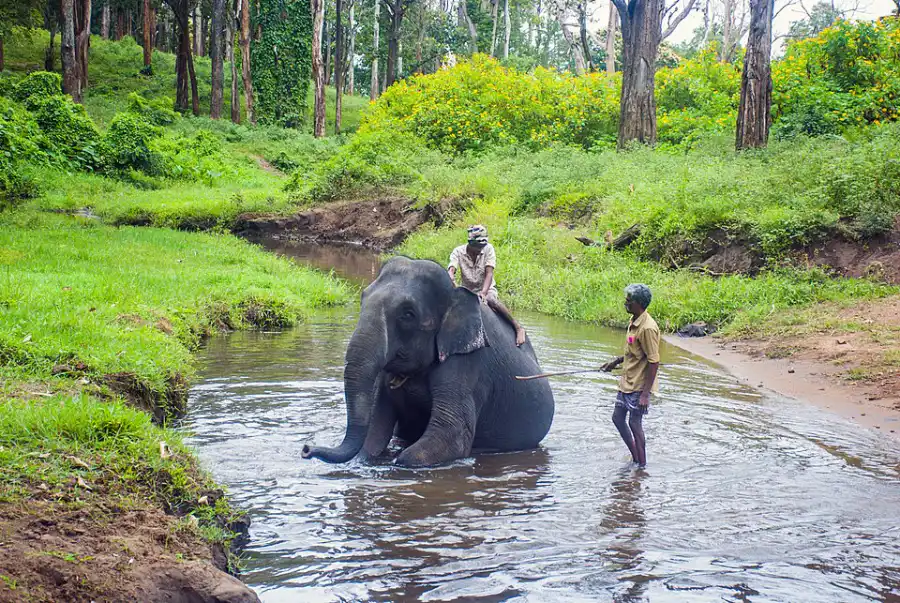
Not exactly.
As elephants disappeared from many Western circus rings, close-contact elephant tourism remained popular elsewhere.
Elephant rides became bucket-list experiences. Visitors could bathe elephants, swim beside them, feed them, take selfies, or spend a day acting as an elephant “caretaker.”
Some of these experiences were marketed as more ethical alternatives to circuses and performances.
But animal-welfare researchers increasingly warn that an attraction can look gentle to a visitor while still limiting an elephant’s ability to choose whether it participates.
This is where the next chapter of our relationship with elephants becomes complicated.
In Thailand, for example, elephant riding has declined dramatically. World Animal Protection reported that the percentage of captive tourism elephants used for rides fell from 92% in 2010 to 43% in 2024.
That sounds like enormous progress, and in many ways, it is.
But during the same period, close-contact activities such as elephant washing and “caretaking” became more common. More than half of the elephants assessed in its 2024–2025 research lived at venues offering washing or caretaking interactions. Researchers warned that these experiences can still deny elephants choice and require repeated interaction with tourists.
In other words, the attraction changed.
The underlying question didn’t:
Is the elephant choosing the interaction, or is the elephant required to participate because people paid for the experience?
Some countries are beginning to respond. At the end of 2025, Indonesia issued a directive ending elephant rides at conservation and tourism facilities nationwide, with facilities implementing the change in 2026. More than 200 travel companies worldwide have also committed to policies moving away from elephant rides and other exploitative wildlife experiences.
Meanwhile, observation-only elephant experiences are growing. Instead of touching, riding, washing, or directing an elephant, visitors watch elephants forage, socialize, explore, and simply behave like elephants.
Perhaps that is the biggest cultural change of all.
For generations, we paid to see what humans could make an elephant do.
Now, we’re learning to appreciate what elephants do when we leave them alone.
From Circus Stars to Conservation Icons
Elephants haven’t stopped captivating us.
They still appear in children’s books and movies. We still travel across the world hoping to see them. Their intelligence, massive size, close family relationships, communication, and personalities continue to fascinate us.
But what we celebrate is changing.
Once, an elephant balancing on a pedestal demonstrated the wonder of the animal.
Today, we might be more amazed by a matriarch leading her family across the landscape, an elephant communicating with another beyond our hearing, a herd caring for a calf, or a forest elephant dispersing seeds through the rainforest.
And perhaps elephants themselves helped us make that transition.
Their worldwide popularity made their treatment difficult to ignore. The same emotional connection that once drew crowds to performing elephants eventually helped generate questions about whether those performances should continue.
That doesn’t mean everyone who attended an animal circus was indifferent to animal welfare.
I certainly wasn’t.
The child who became excited when the circus arrived in town, who helped catch an escaped llama and whose personalized storybook involved rescuing a circus elephant, already loved animals deeply.
What changed wasn’t the love.
It was the knowledge.
The more I learned about wildlife – not just elephants – the more my understanding of what it means to appreciate an animal changed. I learned more about their intelligence and social relationships, natural behaviors, individual needs, and the roles different species play within their ecosystems. I learned how much everything is connected and how much nature itself can change by simply removing or adding another species. I also learned how much we still don’t know.
Elephants are a perfect example. The more we understand about their complex family lives, communication, intelligence, home ranges, and importance to the ecosystems around them, the harder it becomes to see them simply as animals that exist for our entertainment.
And that may be one of the most important lessons wildlife can teach us about conservation.
Awareness changes our relationship with wildlife.
Sometimes learning more about an animal makes us want to see it.
Sometimes it makes us want to touch it.
But sometimes, if we keep learning, we realize that the greatest expression of our fascination isn’t asking an animal to entertain us at all.
It is allowing that animal to be exactly what it is.
Keep Exploring
Want to learn more about the elephants behind the story?
Meet the African forest elephant—the smaller, more elusive cousin of the African savanna elephant. Discover how these rainforest giants communicate, shape entire ecosystems, raise their families, and why their future matters far beyond the forests they call home.
→ Meet the African Forest Elephant
How You Can Help the African Forest Elephant
- Choose FSC-Certified Wood and Paper: Illegal logging is one of the biggest threats to African rainforests. When purchasing wood products, furniture, paper, or flooring, look for the Forest Stewardship Council (FSC) certification. FSC-certified products come from responsibly managed forests that help reduce habitat destruction.
- Buy Rainforest-Friendly Chocolate and Coffee: Many products grown in tropical regions can contribute to deforestation if produced unsustainably. Choosing Rainforest Alliance Certified or similarly certified coffee, cocoa, and tea supports farming practices that better protect wildlife habitat.
- Never Buy Ivory: Avoid purchasing ivory products or souvenirs, even antiques, unless you know they comply with wildlife laws. Every informed purchase helps reduce demand for elephant ivory and discourages illegal poaching.
- Share Their Story: Most people have never heard of the African Forest Elephant. Sharing a conservation article, factsheet, or social media post can help introduce others to this lesser-known species and the challenges it faces.
- Reduce Your Paper Waste: Using both sides of paper, choosing recycled paper products, and reducing unnecessary printing can help decrease demand for timber and reduce pressure on forests worldwide.
- Support Ethical Zoos and Conservation Organizations: Many accredited zoos and conservation organizations contribute to elephant research, anti-poaching efforts, and rainforest conservation. Even small donations or memberships help fund important work. Some charities that focus on elephant conservation include the International Elephant Foundation and Sheldrick Wildlife Trust.
- Plant a Tree: While planting a tree won’t directly restore African rainforest habitat, supporting local reforestation projects or organizations that restore tropical forests helps combat climate change and raises awareness about the importance of healthy forests.
- Learn Before You Share: Help fight wildlife misinformation by learning from reputable conservation organizations and sharing accurate information with friends, family, and on social media.
- ♻️ Reduce Your Carbon Footprint: Climate change affects rainforest ecosystems and the fruiting cycles of many tree species that forest elephants depend on. Walking, biking, conserving energy, and reducing waste are small actions that collectively make a difference.
- Raise awareness through social media about these elephants and the dangers they currently face.
- Lastly, Shop with purpose: Purchases from Artsefact help support wildlife and habitat conservation.
10% of all profits support wildlife and habitat conservation efforts, so every artwork you collect helps protect the planet.
African Forest Elephant Factsheet
Would you like an African Forest Elephant fact sheet?
- Sign up for our newsletter for exclusive updates and wildlife conservation tips (Your welcome email has your Password for the Portal)
- Visit https://artsefact.com/factsheets/ where you can access and download ALL Factsheets & Gain Early Access to NEW Factsheets
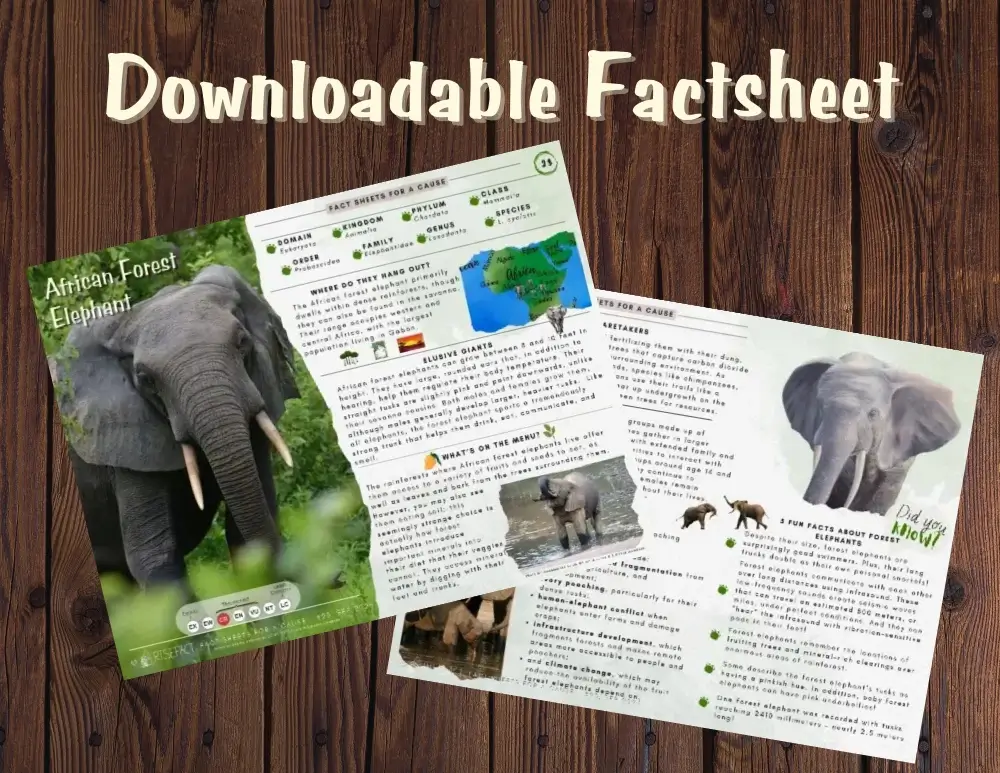
Here’s how you can gain access:
Resources
- Elephant: “Living African elephants belong to two species: Loxodonta africana (Blumenbach, 1797) and Loxodonta cyclotis (Matschie, 1900)” – https://digitalcommons.wayne.edu/cgi/viewcontent.cgi?article=1140&context=elephant
- IUCN Redlist – https://www.iucnredlist.org/species/181007989/204404464#geographic-range
- World Wildlife Fund:
- https://africa.panda.org/?57064/First-status-report-on-the-African-forest-elephant-Giants-of-the-forest-in-danger
- https://www.worldwildlife.org/species/elephant/african-elephant/african-forest-elephant/
- https://www.worldwildlife.org/species/elephant/african-elephant/african-savanna-elephant/
- https://www.worldwildlife.org/species/elephant/asian-elephant/
- https://www.worldwildlife.org/resources/facts/whats-the-difference-between-asian-and-african-elephants-and-9-other-elephant-facts/
- African Wildlife Foundation:
- Smithsonian Magazine – https://www.smithsonianmag.com/science-nature/how-humans-benefit-highway-trails-created-african-forest-elephants-180976045/
- Global Conservation – https://globalconservation.org/endangered-species/african-forest-elephant
- San Diego Zoo Wildlife Alliance – https://ielc.libguides.com/sdzg/factsheets/african_elephant/characteristics
- Historical Biological: “Estimating tusk masses in proboscideans: a comprehensive analysis and predictive model” – https://www.tandfonline.com/doi/pdf/10.1080/08912963.2023.2286272?needAccess=true
- Animalia – https://animalia.bio/african-forest-elephant
- National Geographic: “African Elephants Really Two Wildly Different Species?” – https://www.nationalgeographic.com/animals/article/101222-african-elephants-two-species-new-science
- Wildlife SOS – https://news.wildlifesos.org/8-fascinating-facts-about-an-elephants-trunk/
- NASA – https://science.nasa.gov/earth/earth-observatory/dzanga-bai-elephant-enclave-149945/
- Cornell University:
- Mongabay – https://news.mongabay.com/2026/04/a-unique-clearing-in-central-africa-draws-elephants-from-the-dense-forests/
- National Library of Medicine: “Memory-Based Navigation in Elephants: Implications for Survival Strategies and Conservation” – https://pmc.ncbi.nlm.nih.gov/articles/PMC12030947/#sec2-vetsci-12-00312
- Wikipedia:
- “African forest elephant” – https://en.wikipedia.org/wiki/African_forest_elephant
- “Old Bet” – https://en.wikipedia.org/wiki/Old_Bet
- “Flagship species” – https://en.wikipedia.org/wiki/Flagship_species
- The Guardian: ” ‘The end of an era’: Ringling Bros circus closes curtain on elephant shows” – https://www.theguardian.com/stage/2016/may/02/ringling-brothers-elephants-circus-final-show
- Mammia: “A life of abuse and a tragic end: The true story of the real-life Dumbo.” – https://www.mamamia.com.au/dumbo-real-story-jumbo-the-elephant/
- Science Direct:
- “Large brains and cognition: Where do elephants fit in?” – https://pinterwollmanlab.eeb.ucla.edu/wp-content/uploads/sites/86/2016/05/elephant-cognition-2008.pdf
- “Megagardeners of the forest – the role of elephants in seed dispersal” – https://www.sciencedirect.com/science/article/abs/pii/S1146609X11000154
- Journal of Consciousness Studies: “Do Elephants Show Empathy?”- https://dspace.stir.ac.uk/bitstream/1893/946/1/2008%20Bates_et_al_JCS.pdf
- Elephant Voices:
- KQED – https://www.kqed.org/science/1926248/how-elephants-listen-with-their-feet
- Elephant Aid International – https://elephantaidinternational.org/fun-facts/why-elephants-cant-jump/
- BBC Wildlife – https://www.discoverwildlife.com/animal-facts/mammals/elephant-graveyards-truth
- The Living Lore: “Elephant Symbolism and Cultural Significance” – https://thelivinglore.com/elephant-symbolism-and-cultural-significance/
- Wissenschaftskolleg zu Berlin: The Conservation Applications of Research on Elephant Behaviour and Ecology” – https://www.wiko-berlin.de/veranstaltungen/workshops/2017/the-conservation-applications-of-research-on-elephant-behaviour-and-ecology
- Smithsonian Magazine “The Complicated History of the Human and Elephant Relationship” – https://www.smithsonianmag.com/smithsonian-institution/complicated-history-human-and-elephant-relationship-180970858/
- Wayne State University / Elephant journal “Jumbo: Origin of the Word and History of the Elephant” – https://digitalcommons.wayne.edu/elephant/vol2/iss2/14
- BnF / Centre National des Arts du Cirque — “Elephants” – https://cirque-cnac.bnf.fr/en/animal-training/wild-animals/elephants
- Circus Historical Society Old Bet research – https://classic.circushistory.org/Bandwagon/bw-1973Nov.htm
- National Geographic, Ringling’s retired circus elephants – https://www.nationalgeographic.com/animals/article/ringling-bros-circus-elephants-get-new-home and https://www.nationalgeographic.com/animals/article/150916-ringling-circus-elephants-florida-center
- TIME, history behind Ringling’s elephant decision – https://time.com/3733595/elephants-barnum-bailey-history/
- https://www.worldanimalprotection.org/latest/news/captive-elephants-thailand-tourism-welfare-report-2026/
- https://www.worldanimalprotection.org/elephant-friendly-tourist-guide
- https://warfarehistorynetwork.com/article/history-of-war-elephants-from-ancient-india-to-vietnam/
- https://www.boweryboyshistory.com/2017/03/big-story-old-bet-americas-first-circus-elephant.html
- https://www.pbs.org/wnet/nature/distant-cousins/2308/
- https://www.latimes.com/archives/la-xpm-2011-jan-16-la-ca-sneaks-april-water-for-elephant20110116-story.html
- https://www.latimes.com/archives/blogs/24-frames/story/2011-12-01/water-for-elephants-lawsuit-is-dismissed
- https://www.theguardian.com/film/2011/may/10/water-for-elephants-abuse-claims
- https://www.roncalli.de/historie/
- https://www.cbsnews.com/news/ringling-bros-eliminating-elephant-acts-amid-public-mood-shift/
- https://www.cbsnews.com/news/ringling-bros-and-barnum-bailey-circus-elephants-to-retire-in-may/
- https://d23.com/a-to-z/dumbo-film/
- https://www.worldanimalprotection.org/latest/news/indonesia-bans-elephant-riding-to-protect-welfare/
- https://www.americanhumane.org/production/water-for-elephants/
- https://www.cambridge.org/core/journals/comparative-studies-in-society-and-history/article/alexander-and-the-elephants/70C83EB49C6C8593AF2F96D6FC41B643
- https://www.cambridge.org/core/journals/greece-and-rome/article/abs/decline-of-ptolemaic-elephant-hunting-an-analysis-of-the-contributory-factors/1BEF25159E2AAAB34D07162FBE5A11C9
- https://www.cambridge.org/core/journals/greece-and-rome/article/abs/tactical-handling-of-the-elephant/C0078B1E0113FC8672B4E5B8F3C2748B
- https://penelope.uchicago.edu/encyclopaedia_romana/gladiators/venationes.html
- https://penelope.uchicago.edu/Thayer/E/Roman/Texts/secondary/SMIGRA%2A/Venatio.html


.PNG)


